Pharmacy Business Continuity Plan: Control Work During Downtime
Build a pharmacy business continuity plan for power, internet and software downtime, with secure records, customer updates and recovery reconciliation.

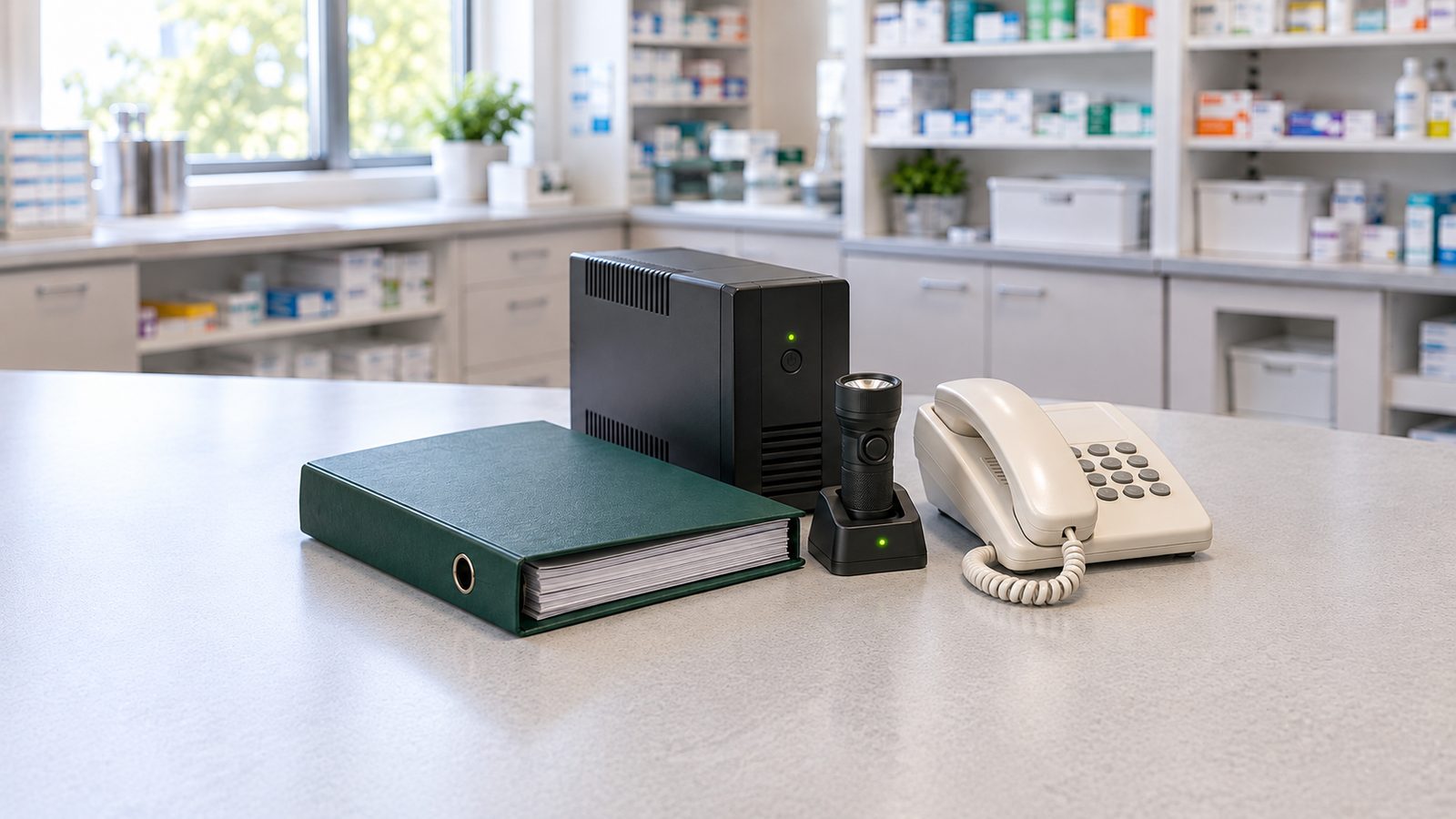
in the Australian Government template: continuity, emergency action and recovery, checked October 2026
Source: business.gov.auASD guidance recommends testing recovery of data, applications and settings together, checked October 2026
Source: ASD, Guidelines for system managementrequires reasonable security steps for personal information held by Australian APP entities, including temporary records
Source: OAIC, APP 11 guidanceIn this article
A pharmacy business continuity plan defines who acts, which administrative work can continue, and how records are reconciled after disruption.
Consider an illustrative outage: the till reconnects, but a promised callback and a collection update remain on loose notes. Technical recovery has happened; those commitments still need owners.
Plan for power, internet and software downtime before the team needs a fallback. The workflow below offers practical recommendations to adapt to your pharmacy.
Clinical decisions, medicine storage and lawful dispensing remain with qualified staff, approved pharmacy policies and applicable regulator guidance.
Build your pharmacy business continuity plan around dependencies
The Australian Government emergency management template has three sections: continuity, emergency action and recovery. Use that structure to cover preparation, the interruption and the return to normal work.
Start with work customers already expect: callbacks, collections, bookings, deliveries and supplier queries. Map each task to its systems, communication channels and responsible role.
Use the existing pharmacy workflow map to identify where requests wait. Add a permitted fallback, a pause condition and a recovery check for each dependency.
| Disruption | Confirm first | Administrative response | Evidence before normal work resumes |
|---|---|---|---|
| Power loss | Premises status and affected equipment | Activate the approved emergency plan; pause unsupported commitments | Responsible staff approve reopening and equipment checks |
| Internet loss | Which applications and contact channels are affected | Use a previously approved, tested alternative or controlled downtime intake | Required connections and task access are checked |
| Software unavailable | Affected functions and last confirmed completed work | Record requests without assuming their transaction status | Vendor recovery advice and reconciliation checks are completed |
Ask providers what depends on connectivity, how status updates are accessed, and who authorises restoration. Record support contacts somewhere accessible when the usual system is unavailable.
For electronic prescribing, ADHA directs dispensers to check legislation specific to their state or territory. Refer dispensing questions to the responsible pharmacist rather than improvising an administrative workaround.
Activate deliberately and name an incident owner
Define activation criteria around lost capability, unreliable records and commitments the team cannot fulfil. Include who can pause services and who can approve their return.
At activation, record the incident reference, start time, affected functions and last trusted status. Distinguish confirmed information from assumptions awaiting provider advice.
Name an incident owner and deputy. Assign customer communication, temporary records and recovery reconciliation to named people, with an escalation contact for each.
If suspicious activity accompanies the outage, invoke the approved cyber response process and contact the designated technical responder. Let that process govern device changes and restoration.
ASD’s incident response guidance connects cyber response with business continuity, communication and reporting arrangements. Keep those responsibilities visible alongside the operational fallback.
Give customers a usable service expectation
Prepare messages for the counter, phone and available digital channels. State which service is affected, what the team can currently confirm and how customers can contact staff.
Give a supported next update time, even when the restoration time is unknown. Assign someone to refresh messages when the situation changes.
An illustrative message is: “Our order system is unavailable. Staff will check your request and explain the next step. Our next service update is at 2 pm.”
Choose the update time from available staffing and confirmed information. Do not present a provider estimate as a guaranteed collection time.
Check incoming channels as well as outgoing notices. A message should direct people to a route the team can actually receive and monitor.
Route clinical urgency to qualified staff under the pharmacy’s local escalation policy. Record customer commitments so the next shift can see who needs an update.
Keep one protected downtime record
Use a controlled temporary register with an identifiable custodian. Give each item a unique reference so later reconciliation can distinguish separate requests and duplicates.
Suggested administrative fields are:
- incident and item reference, with date and time
- request type and source channel
- minimum identifying and contact details required by the approved process
- confirmed status, or an explicit “unknown”
- customer commitment and next action
- named owner, escalation point and reconciliation link
Keep clinical documentation in the pharmacist’s approved process. A temporary intake note does not establish that a medicine is ready, paid for or supplied.
For Australian APP entities, OAIC’s APP 11 guidance requires reasonable steps to protect held personal information. Its guidance includes loss of hard copy documents and electronic records.
Restrict access to downtime records and secure paper when unattended. Use approved storage and communication methods, avoiding personal messaging accounts and photographs on personal phones.
Agree retention and disposal handling before an incident. Reconciliation alone is not permission to destroy records; check continuing business needs, legal retention requirements and incident instructions.
Recover in stages and reconcile unfinished work
ASD’s system management guidance recommends coordinated restoration tests covering data, applications and settings at a common recovery point. Treat this as technical planning guidance, not a universal pharmacy legal rule.
For operational recovery, use this suggested sequence:
- Obtain the authorised recovery decision and record any known gaps or limitations.
- Check required system access and confirm which queued actions already completed.
- Match temporary items to their owning records, preserving references and avoiding duplicate entry.
- Resolve unclear outcomes through the responsible staff member or provider before repeating an action.
- Update customers, assign remaining exceptions and document who approved incident closure.
Before resubmitting a payment or order, have authorised staff establish whether the original operation completed. Record uncertain outcomes for review rather than marking them successful.
Keep the incident open while reconciliation continues. Use the shift handover checklist if responsibility changes before outstanding items are resolved.
Rehearse the whole cycle
In its data recovery discussion, ADHA advises involving the technology provider, testing backups and practising incident response.
An illustrative tabletop exercise could combine unavailable internet with the usual incident owner being absent. Use fictional requests and test records rather than disconnecting live systems.
Ask staff to locate the plan, reach the deputy, choose a usable contact channel, secure temporary notes and reconcile the simulated backlog.
Government planning guidance recommends rehearsing and regularly reviewing the plan. Review exercise findings and changes to staff, systems or providers, then assign improvements to owners.
Keep the approved plan accessible, versioned and familiar to the team. For wider technology planning, use our AI in pharmacy guide alongside this downtime workflow.
Frequently asked questions
- What should a pharmacy business continuity plan include?
- Include activation triggers, system dependencies, permitted fallback work, incident ownership, customer messages, secure temporary records, escalation contacts, recovery checks and rehearsal.
- Can a pharmacy continue dispensing when its software is unavailable?
- The responsible pharmacist must determine permitted actions under pharmacy policy and applicable jurisdictional requirements; this administrative continuity guide does not authorise dispensing workarounds.
- What belongs in a pharmacy downtime record?
- Record the minimum approved identifying information, item reference, time, request, known status, commitment, owner, next action and eventual reconciliation link.
- When can a pharmacy close a downtime incident?
- Close it after authorised recovery checks, reconciliation of temporary and queued work, customer updates, and assignment of any remaining exceptions.
Sources
- Develop an emergency management plan · Australian Government, business.gov.au
- Guidelines for system management · Australian Signals Directorate
- Chapter 11: APP 11 Security of personal information · Office of the Australian Information Commissioner
- Electronic prescribing for dispensers · Australian Digital Health Agency
- Cyber security incident response planning: Practitioner guidance · Australian Signals Directorate
- Data recovery tips: Do you have a response plan? · Australian Digital Health Agency