Why pharmacy workflows stay fragmented after going digital
Explore Australian and international evidence on pharmacy workflow fragmentation: prescription channels, staff handoffs, stock checks and responsibilities.


ADHA's 2023 research describes time-consuming prescription-format management
Source: Australian Digital Health AgencyCanada's 2022 survey illustrates mixed record formats, not current prevalence
Source: Canada Health InfowayIn this article
A prescription can be digital while the work around it remains fragmented. Pharmacy workflow fragmentation occurs when staff must bridge gaps between requests, systems, records and people.
Imagine a patient calling about a prescription. One person checks the dispensing system, another checks stock, and a clarification sits in a separate communication channel.
This is an illustrative scenario, not a description of every pharmacy. It shows why digitising individual steps does not necessarily connect the whole service.
Australian and international studies document related pressures. They support investigating the handoffs, while leaving important limits on what can be claimed about their causes or frequency.
Our electronic prescriptions guide explains the prescription channels behind some of these handoffs.
Key facts
- ADHA’s 2023 research describes the work of managing multiple prescription formats, alongside benefits from electronic prescribing.
- International studies describe related pressures, but do not establish a global fragmentation rate or a single software cause.
- Use the illustrative diagram to examine local handoffs, unresolved exceptions and responsibility for the next action.
Why does pharmacy workflow fragmentation survive digitisation?
A completed entry does not always mean completed work. A digital system can organise its records well while the next person still needs an answer.
The records serve different purposes:
- A stock record concerns availability.
- A prescription record concerns a particular request.
- A communication thread records what someone has been told.
Integration can pass information between those records. People still need to agree who acts on it, what requires review and how they recognise unfinished work.
The original workflow sketch behind this article highlights staff connecting stock activity, dispensing, records and patient communication. Its useful insight is the number of handoffs.
A sketch shows a possible relationship between tasks. Research is needed to establish how often a particular problem occurs and what causes it.
What does Australian evidence show?
In its 2023 electronic-prescription research, the Australian Digital Health Agency surveyed 429 dispensers.
Its report describes managing multiple prescription formats as time-consuming. It also recognises electronic prescribing’s safety benefits and identifies token management, Active Script List functionality and support as improvement areas.
These findings can coexist. A system may improve an important part of prescribing while staff still experience friction around formats and related work.
Published in 2022, the SPICE observational study followed 24 pharmacists across 15 community pharmacies in Western Australia and New South Wales. Observations totalled more than 274 hours.
In that sample, pharmacists performed an average of 25 tasks per hour and were interrupted approximately every 19 minutes.
Those observations describe selected pharmacies. They are not national averages, and the study does not establish disconnected software as the cause of every interruption.
The distinction is useful for owners: evidence of task switching supports examining the work, but does not by itself identify which integration to buy.
How should you read the workflow diagram?
The diagram separates stock and supply, dispensing and records, and requests and communication. The central team reconciles information, prioritises work and follows up.
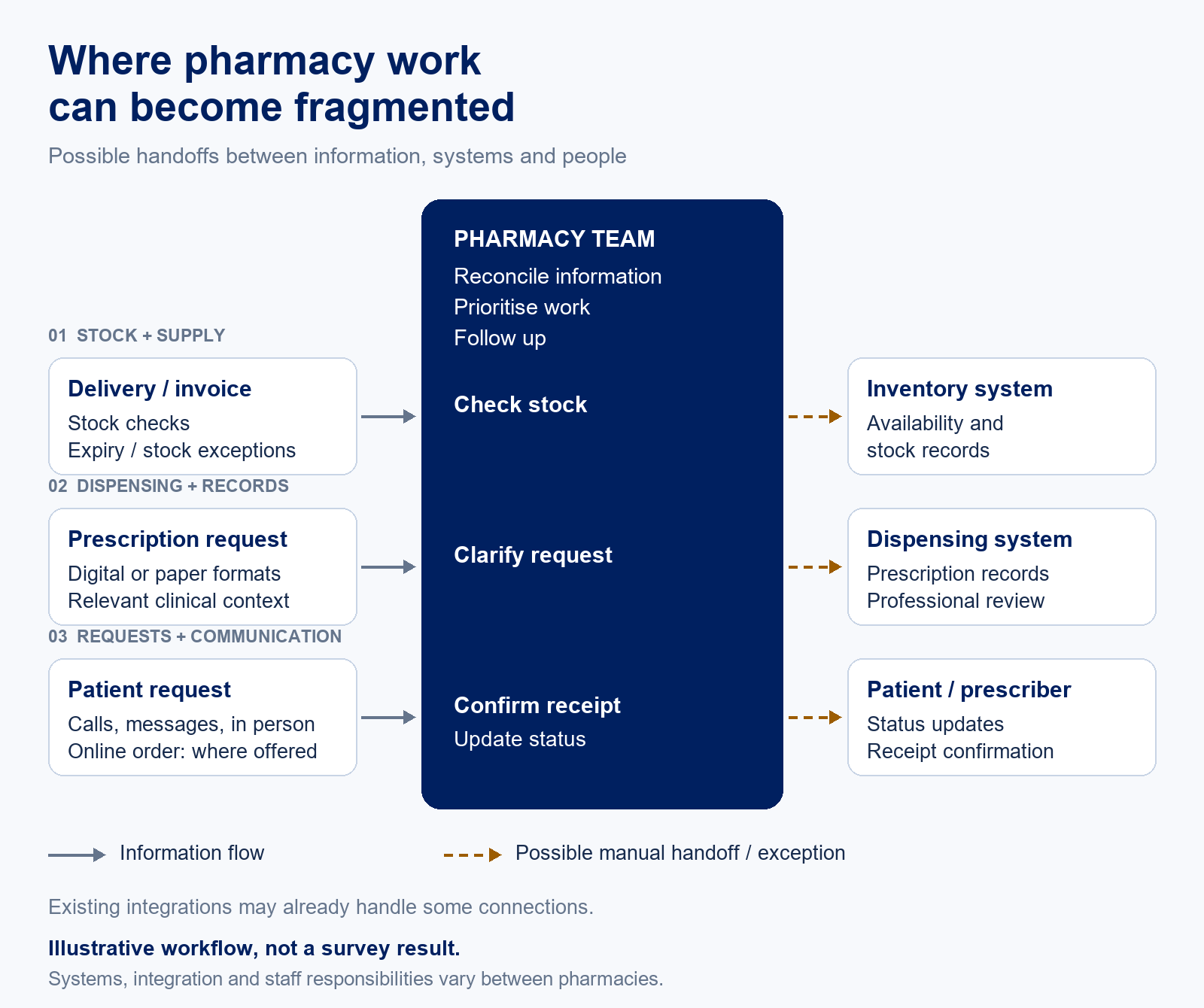
Illustrative workflow, not a survey result. Systems, integration and staff responsibilities vary between pharmacies.
Open the full-size workflow diagram.
Solid lines show ordinary information flow. Amber dashed lines identify possible manual handoffs or exceptions, such as checking stock, clarifying a request and confirming receipt.
Online ordering is marked “where offered”. Expiry checks are presented as stock exceptions to review, without claiming that unnoticed stock loss is universal.
Existing dispensing and inventory integrations may already handle some connections. The diagram is a way to discuss local gaps, not a recommended technical architecture or a generic destination for clinical records.
What do international studies tell us?
International evidence helps distinguish a broader coordination problem from a problem unique to one Australian setting. However, different methods and dates prevent a single global estimate.
| Setting and source | What the evidence contributes | What it cannot establish |
|---|---|---|
| Australia, ADHA research in 2023 | Dispensers’ experience of multiple prescription formats | Current prevalence of every disconnected workflow |
| Australia, SPICE observations | Task switching in a selected community-pharmacy sample | A national average or software causation |
| England, 2025 supply survey | Staff estimates of stock-sourcing workload | That software caused medicine shortages |
| Wisconsin, US community pharmacies | Examples of interruption mechanisms | A nationwide interruption rate |
| Canada, 2022 pharmacist survey | A historical mix of paper and electronic records | Today’s setup in every pharmacy |
| New Zealand, 2020 interviews | Communication and timing difficulties alongside benefits | National frequency of system defects |
In England, Community Pharmacy England’s 2025 survey found that 39% of staff respondents estimated stock sourcing took their team one to two hours daily.
Another 26% reported more than two hours. These are staff estimates about obtaining stock or alternatives, not timed observations or evidence that disconnected software caused shortages.
A US observational study was published online in 2018 and in the journal’s October 2019 issue. Across six Wisconsin community pharmacies, it identified interruptions involving telephone calls, patient queries, colleagues and technology.
That small local study helps explain how interruptions arise. It does not justify a single US-wide rate.
Canada’s 2022 dispensing-workflow survey reported that 67% of respondents used both paper and electronic records in their pharmacy; 27% reported paperless operation.
The methodology records 610 community-pharmacist respondents. Treat these as historical reports of workplace arrangements, rather than a current audit of all Canadian pharmacies.
In New Zealand, interviews conducted in late 2020 with four GPs and four community pharmacists found benefits alongside timing, expectations and communication challenges.
That small qualitative sample illustrates possible failure points. It cannot establish their national frequency or show that today’s systems have unchanged defects.
Ask what the handoff still requires
Begin with one unresolved handoff. ADHA’s research identifies token management and support as improvement areas, but it cannot identify your pharmacy’s bottleneck. A local review must establish what staff are waiting for and who can resolve it.
For a fictional prescription query, distinguish three questions:
- Received: Has the request reached the intended system or person? Check what the status actually confirms.
- Assessed: Has the responsible pharmacist considered the request, or is clarification still needed?
- Followed up: Who will give the patient the next update, and where can colleagues see that commitment?
These are discussion questions, not standard software status codes. A demonstration should show the unresolved case as well as the successful one. Ask who receives a failed handoff and how they find the original context.
Keep clinical judgement and patient access central. Do not remove a safety check because it takes time, or copy patient information into an unapproved shared tool.
For the practical next step, use our workflow optimisation guide to examine a local process. The shift handover checklist addresses transferring responsibility for open work.
Krepko’s pilot framing
KSuite and its modules are in pilot. Our intended ownership model gives KDash the operational view and attention layer, while module records remain their sources of truth.
Kat owns requests and follow-up; KSafe owns inventory activity; KShop owns the order workflow; KMail owns governed campaign behaviour.
These boundaries describe the pilot model, not a claim that every connection is implemented or that measured savings have been achieved.
In a pilot discussion, ask which record each proposed view reads, who can change that record and how staff handle a failed transfer. Agree the answers for the proposed scope; the module name alone does not establish them.
Explore the KDash pilot in that context. Any proposed fit should be assessed against the pharmacy’s actual systems, permissions and responsibilities.
Digital progress is valuable. Understanding the work that remains between systems gives owners a more precise basis for deciding what should change next.
Frequently asked questions
- What is pharmacy workflow fragmentation?
- Pharmacy workflow fragmentation occurs when staff repeatedly bridge gaps between requests, systems, records and people to complete work.
- Does electronic prescribing remove every pharmacy handoff?
- No. Electronic prescribing can provide benefits while formats, stock queries, clarifications and communication still require coordination.
- Is the workflow diagram a survey of Australian pharmacies?
- No. It is an illustrative discussion tool; systems, integrations and responsibilities vary between pharmacies.
- Do international studies prove disconnected software causes pharmacy workload?
- No. They describe related pressures using different methods and historical samples; they do not establish one global rate or a universal software cause.
Preparation note
Prepared with AI-assisted drafting, separate Codex reader reviews and primary-source checks on 19 October 2026. Examples and generated images are illustrative; source scope and limitations are stated in the article.
Publisher: Krepko.
Sources
- Exploring electronic prescriptions: Australian research report · Australian Digital Health Agency · Retrieved
- Community pharmacy workflow: SPICE study · BMJ Open · Retrieved
- 2025 Medicines Supply Report · Community Pharmacy England · Retrieved
- Interruptions in Community Pharmacies: Frequency, Sources, and Mitigation Strategies · Research in Social and Administrative Pharmacy · Retrieved
- 2022 pharmacist survey: dispensing workflow · Canada Health Infoway · Retrieved
- National pharmacists survey methodology · Canada Health Infoway · Retrieved
- Electronic transmission of prescriptions in primary care: transformation, timing and teamwork · Journal of Primary Health Care · Retrieved